

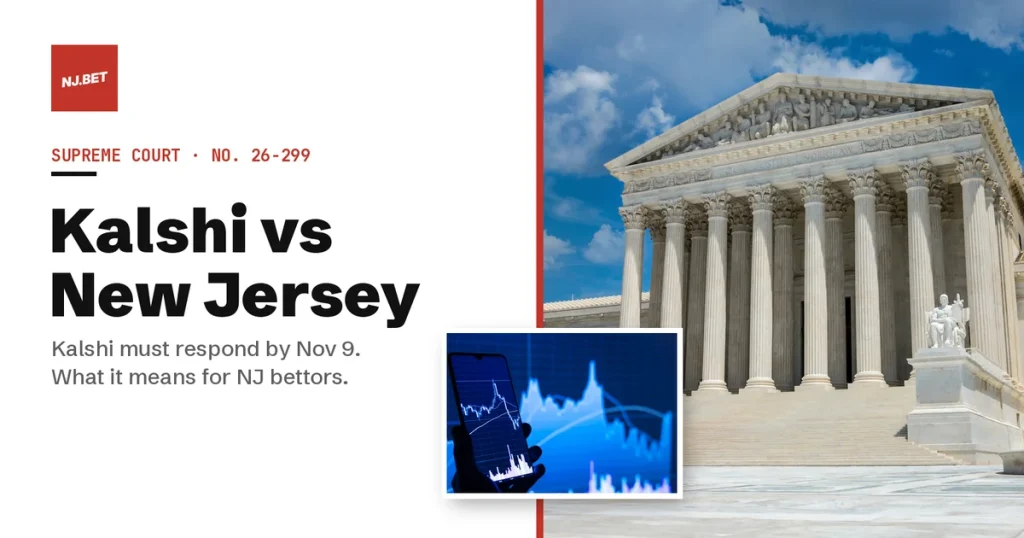
Kalshi has until November 9 to tell the U.S. Supreme Court why it should not take New Jersey’s case against it. That deadline, pushed back from October 8 at the request of Kalshi’s counsel Neal Katyal, is the next step in Flaherty v. KalshiEX (No. 26-299), the dispute over whether a federally registered exchange can offer sports event contracts in New Jersey without a state gambling license. Until the justices act, nothing changes on the ground: a federal injunction still bars the Division of Gaming Enforcement from going after Kalshi’s sports contracts.
The Kalshi petition, from the Third Circuit to the Supreme Court
New Jersey lost round two on April 6, 2026. A divided Third Circuit panel voted 2-1 to uphold the preliminary injunction, with Judge Porter writing for the majority, Chief Judge Chagares joining and Judge Roth dissenting. The court found Kalshi likely to win its argument that federal commodities law, as amended by the 2010 Dodd-Frank Act, preempts state gambling rules for contracts listed on a CFTC-registered exchange.
Attorney General Jennifer Davenport and interim DGE director Mary Jo Flaherty took two filing extensions before submitting the petition on September 2. It was docketed on September 8. The question: are Kalshi’s sports contracts swaps under exclusive federal oversight, or sports wagers New Jersey can license, tax and police?
Why the justices may hear it: a three-circuit split
New Jersey’s best argument for review is that other appeals courts have since gone the other way:
- Ninth Circuit, August 28: ruled for Nevada, rejecting Kalshi’s claim that its sports contracts are federally regulated swaps.
- Ninth Circuit, September 16: in Blue Lake Rancheria, held Kalshi’s sports contracts are class III gaming.
- Sixth Circuit, September 25: ruled for Ohio and Tennessee, adding that even if the contracts were swaps, federal law would not displace state gambling rules.
“These decisions cannot be reconciled,” the International Association of Gaming Regulators and the North American Gaming Regulators Association wrote in their October 2 brief. Robinhood and Crypto.com’s North American Derivatives Exchange have also filed petitions on the same question.
The docket has filled up fast. Attorneys general from 39 states and D.C. backed New Jersey on October 7. On October 8 came briefs from the NFL, the American Gaming Association, the Casino Association of New Jersey, 145 tribes, former CFTC chairman Gary Gensler and former senator Christopher Dodd, whose name is on the very law Kalshi relies on. The Cabazon Band of Cahuilla Indians said its legal director placed a $25 Kalshi bet on the Vikings from its California reservation, where sports betting is not authorized.
Washington is moving the other way. On October 9 the CFTC proposed adding event contracts tied to sports, politics, culture and weather to its definition of “swap,” opening a 30-day comment window after Federal Register publication. Chairman Michael Selig called them “commodity derivatives squarely within the CFTC’s regulatory remit.” Kalshi CEO Tarek Mansour said in Dublin on October 21 that the fight could end at the Supreme Court.
What the Kalshi case means for New Jersey bettors today
Kalshi’s sports contracts remain available in New Jersey. The practical difference for players is the rulebook. The state’s licensed sportsbooks answer to the DGE on age limits, self-exclusion and which events can be offered. The regulators’ brief warns that, because of the split, those protections are enforceable against prediction markets in some states and not others. Ohio regulators alleged in April that Kalshi offered sports contracts to 18-to-20-year-olds; Kalshi has disputed state jurisdiction throughout.
Trenton has bills in the hopper. S3692 would limit sports markets to licensed or partnered New Jersey sportsbooks, and S4447 would tax prediction markets at the 19.75% sportsbook rate plus a 10% surcharge. Neither has been enacted.
Our prediction markets guide explains how event contracts work, and our NJ gambling law explainer sets out what the state licenses. Welcome offers on the licensed side are tracked on our sportsbook bonus page; all are 21+.
Our view: the revenue numbers explain New Jersey’s urgency
The DGE’s September report shows why the state is pressing. Sports wagering revenue fell 14.3% year over year to $77.0 million, and is down 6.3% for 2026 at $748.4 million. Over the same month, online casino win rose 13.0% to $274.8 million, lifting total gaming revenue 2.8% to $579.6 million.
| September 2026 (NJ DGE) | Revenue | YoY |
|---|---|---|
| Sports wagering | $77.0M | -14.3% |
| Internet gaming | $274.8M | +13.0% |
| All gaming | $579.6M | +2.8% |
Sportsbook revenue swings with results, so we would not blame prediction markets alone. But the state collected $15.7 million in sports wagering taxes in September, and it gets none of that from a federally regulated exchange. Our read: review is more likely than not. The split is clean and dozens of governments and leagues are pushing.
Looking ahead to 2027: three scenarios
Trade coverage expects no decision on review before December, and a grant would likely mean oral argument in 2027. Our estimates, based on the Court’s usual practice of deciding argued cases by the end of its term:
- Review granted by January: argument in spring 2027, ruling by late June. A New Jersey win would force Kalshi’s sports markets into state licensing or out; a Kalshi win would make preemption national law.
- Review denied: the split stands, Kalshi’s status depends on which circuit you live in, and the New Jersey case returns to district court on the merits.
- CFTC finalizes its swap rule first: Kalshi gains a stronger preemption argument, though rulemaking takes months and the courts are moving faster.
Either way, 2027 is the likeliest year this gets settled. Until then, keep your live betting on platforms whose rules you understand.
Gambling problem? Call 1-800-GAMBLER. Find support and tools on our responsible gambling page.