


AI agents can compare sports odds, monitor markets and even execute certain event-contract trades. But can they Can an AI agent legally place bets for you in New Jersey? Here’s how the rules work and what residents should know before using one.
Artificial intelligence is changing how we research almost everything. We use ChatGPT and other assistants to compare products, understand complicated subjects and make decisions. Now, AI agents are beginning to complete tasks on our behalf. Sports betting could be next.
Imagine asking an AI assistant to follow the Giants, compare NFL odds and notify you when prices change. Or telling it to monitor a sports event contract and execute a trade when certain conditions are met.
These possibilities sound convenient, but there’s an important distinction between asking AI for information and allowing it to spend your money.
In New Jersey, AI can help you research bets, but that doesn’t mean it can legally or contractually place sportsbook wagers for you. Traditional sportsbooks and federally regulated prediction markets operate under different rules, and New Jersey is involved in an ongoing legal dispute over sports event contracts.
Here’s what you need to know.
What Is Agentic Betting?
Agentic betting means using AI-powered software to perform tasks connected with betting or event-contract trading.
Unlike a conventional chatbot that answers questions, an agent can monitor information and take actions when particular conditions are met.
For example, there are three levels of assistance:
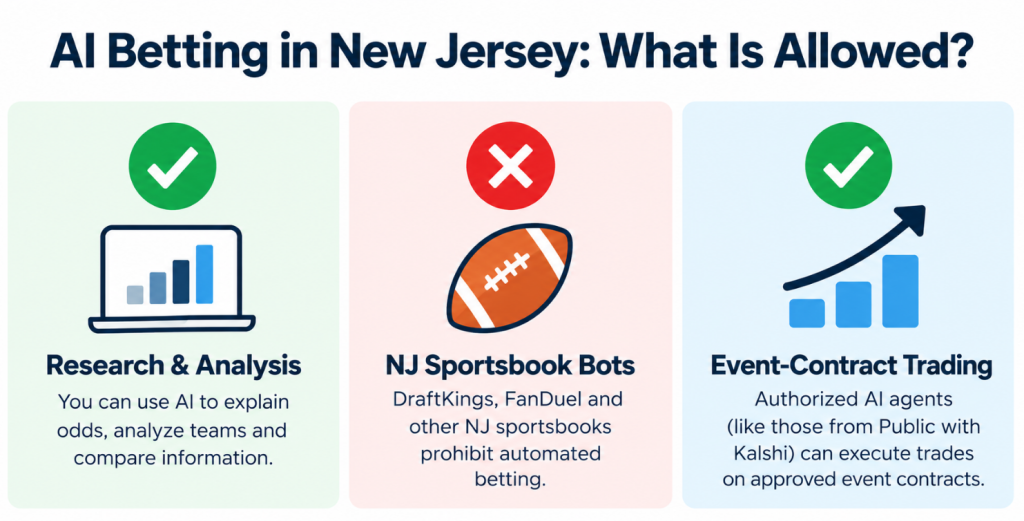
- Research: You ask an AI assistant to explain NFL betting markets, compare prices or analyze team statistics. You make the final decision and place any wager yourself.
- Monitoring: An agent watches specific markets and alerts you when something changes, such as a contract price falling below your chosen threshold.
- Automated execution: Software submits a transaction when predefined conditions are met, without requiring you to approve each individual order.
The final category carries the greatest legal and financial implications.
It also doesn’t mean the AI is independently predicting which team will win. Some agents simply turn your instructions into rules and follow them.
Can AI Agents Already Place Bets or Trade Event Contracts?
In some trading environments, yes. But this should not be confused with permission to automate a conventional sportsbook account.
In September 2026, investment platform Public announced a partnership with prediction-market exchange Kalshi.
On October 4, Public’s AI agent changelog confirmed that its agents could discover and trade event contracts.
The process is relatively straightforward. Customers describe a trading strategy in plain language, review the resulting instructions and approve the plan.
The agent then follows those instructions when the specified conditions occur.
Public describes this as deterministic execution. Its agents don’t independently invent new strategies after approval.
There’s another distinction for New Jersey sports fans: Public’s initial prediction-market offering focuses on financial and economic events rather than unrestricted NFL or NBA wagering.
Still, the development demonstrates that AI agents are beginning to move beyond research and into authorized financial transactions.
That is different from using a general-purpose agent to operate a sportsbook website without permission.
Sportsbooks and Prediction Markets Are Not the Same
New Jersey has a mature legal sports betting market. Operators such as DraftKings, FanDuel and BetMGM accept wagers under the state’s gambling regulations.
Prediction markets offer another way to take financial positions on uncertain outcomes.
Kalshi, for example, operates a federally regulated exchange offering event contracts, including sports-related markets.
Even where a sportsbook bet and an event contract concern the same game, they can differ in their regulatory framework, pricing, eligibility and consumer safeguards.
New Jersey sportsbooks require customers to be at least 21 years old. Kalshi’s published individual account eligibility starts at 18, subject to verification and other restrictions.
That difference does not settle the legal dispute over sports-betting contracts or mean that younger customers can ignore New Jersey’s sportsbook rules.
How Does a Sports Event Contract Work?
Consider a hypothetical contract asking whether the Giants will win their next game. A Yes contract costs $0.60 and pays $1 if the specified outcome occurs.
If you buy one contract for $0.60:
- A successful outcome produces a gross profit of $0.40 before fees.
- An unsuccessful outcome means losing the $0.60 purchase price, plus any applicable fees.
- You may be able to sell before settlement, depending on market liquidity and available prices.
A contract price of 60 cents is often interpreted as an implied probability of approximately 60%. That’s a market estimate, not a verified probability or guarantee.
Before trading, read the actual contract rules. A market asking whether a team wins in regulation time may not be equivalent to a sportsbook wager that includes overtime. Fees, bid-ask spreads, and limited liquidity also affect the value of a position.
Why NJ Sportsbooks Generally Don’t Allow Betting Bots
Major New Jersey sportsbooks explicitly restrict automated wagering.
DraftKings’ New Jersey terms prohibit automated systems, including bots, scripts and AI, from interacting with its service. The restrictions cover both automated wagering and unauthorized information collection.
FanDuel’s New Jersey terms, updated October 15, 2026, likewise prohibit software that automatically places bets.
Modern AI agents can operate browsers and interact with websites much like a person would, but that capability doesn’t authorize their activity.
An agent that logs into a sportsbook and clicks the betting buttons automatically is still using automation, even if the interaction resembles ordinary website use.
New Jersey’s internet gaming regulations also require operators to prohibit the use of automated software for play. The Division of Gaming Enforcement identifies these provisions among the protections applicable to online gambling systems.
The legal requirements and specific sportsbook terms need to be considered together.
For residents, the practical rule is simple: don’t give an AI agent access to your sportsbook account or permission to place wagers unless the operator expressly authorizes that arrangement.
Using AI separately to explain odds or research a matchup is a different activity.
Is Kalshi Legal in New Jersey?
Kalshi’s position is different because it operates a designated contract market regulated by the Commodity Futures Trading Commission (CFTC). That federal regulatory framework is central to an ongoing dispute with New Jersey.
The state argues that sports-event contracts should be subject to its gambling laws, including restrictions on wagering on New Jersey college teams. Kalshi argues that federal commodities law takes precedence over conflicting state restrictions on contracts traded through its federally regulated exchange.
On April 6, 2026, the Third Circuit Court of Appeals upheld a preliminary injunction favoring Kalshi. That ruling provides Kalshi with important protection against the challenged New Jersey enforcement action. However, it isn’t a final nationwide resolution of the issue.
New Jersey petitioned the US Supreme Court in September 2026. As of October, the Supreme Court docket, No. 26-299, shows the petition is pending, with Kalshi’s response deadline extended to November 9.
Other appeals courts have reached different conclusions in related disputes, making the national legal picture uncertain.
What About Rutgers and Seton Hall?
This provides a particularly relevant example of the distinction between sports wagers and event contracts.
Under New Jersey’s sports wagering law, state-licensed sportsbooks cannot take bets on games involving New Jersey college teams, regardless of where they play. College events taking place within New Jersey are also generally restricted, subject to the statute’s specific tournament exceptions.
This affects Rutgers, Seton Hall and other New Jersey colleges.
The dispute with Kalshi raises the question of whether federal regulation prevents New Jersey from applying those state restrictions to event contracts.
Customers shouldn’t treat a prediction market as an automatically lawful way around sportsbook restrictions. They should check both the platform’s eligibility rules and the current status of the disputed contracts.
What Should You Do, and What Should You Avoid, When Using AI for Betting?
The technology itself is not necessarily the problem. The risks come from misunderstanding what an agent is permitted to do, trusting its analysis too readily, or giving it excessive financial authority.
| Do | Don’t |
|---|---|
| Use AI to research teams, odds, and contract rules | Treat AI predictions as guaranteed or proven profitable |
| Verify prices and market conditions with current sources | Assume a chatbot always has live, accurate information |
| Check whether a platform officially allows automated execution | Let a bot place NJ sportsbook wagers without authorization |
| Use approved account integrations where available | Share passwords or verification codes with unknown agents |
| Review trading fees, spreads and settlement conditions | Assume contract prices are identical to sportsbook odds |
| Set clear financial limits and check completed transactions | Give an agent unlimited authority to spend money |
| Respect location, age and account restrictions | Use VPNs or remote systems to circumvent those requirements |
| Understand each platform’s self-exclusion protections | Assume one exclusion automatically applies everywhere |
Be Careful With AI Betting Bots Advertised Online
An unfamiliar website advertising a profitable NFL betting bot should be treated cautiously.
Before connecting any service, investigate who operates it, what permissions it requires and whether the relevant sportsbook or exchange officially supports it.
Be particularly wary of promises of guaranteed profits.
AI models can make mistakes, use outdated information and misunderstand betting-market rules. Even a system that identifies genuine price differences cannot eliminate financial risk.
Avoid Unlimited Automated Trading
An agent following an approved strategy can still lose money. Imagine instructing software to buy an event contract whenever its price falls below 60 cents. The system may execute exactly as instructed. But perhaps the price has fallen because new information makes the outcome less likely.
The agent’s obedience doesn’t make the original strategy sensible.
If you use an authorized trading service, understand its spending limits, how to pause it, whether unfilled orders remain active and what happens to existing positions when the agent is disabled. Turning off an agent doesn’t necessarily cancel transactions already executed.
Can AI Find Better Odds or More Profitable Trades?
AI may be useful for comparing prices. That doesn’t mean it can consistently identify profitable opportunities. For instance, a sportsbook offering decimal odds of 2.05 provides a better potential return than one offering 1.95 on precisely the same outcome.
An AI assistant could recognize that difference without having any special ability to forecast the game.
Comparing sportsbooks with event-contract exchanges is more complicated. You need to account for commissions, trading fees, liquidity and whether both markets settle under identical conditions.
More sophisticated analysis doesn’t remove uncertainty either. A 2026 research preprint examined four major AI models across 104 FIFA World Cup matches. None outperformed betting-market probabilities using the study’s principal forecasting measure.
The study cannot establish how all future AI betting systems will perform. But it illustrates why confident chatbot predictions should not be confused with a demonstrated betting advantage.
NJ Self-Exclusion and Prediction-Market Protections
New Jersey has a statewide self-exclusion program for regulated gambling.
According to the Division of Gaming Enforcement, one qualifying internet-gambling self-exclusion request covers all New Jersey internet gaming and online sports wagering sites.
Prediction-market exchanges have different arrangements.
Kalshi offers its own voluntary self-exclusion and participates in a broader exclusion initiative covering participating prediction-market platforms.
However, Kalshi’s published policy specifically warns that exclusion from its direct services does not necessarily prevent someone from accessing Kalshi products through a futures commission merchant.
This distinction is important.
Customers should not assume that New Jersey’s statewide exclusion program automatically applies to every prediction-market or financial trading account.
And anyone who has self-excluded from gambling should not use AI agents or event-contract platforms to bypass that restriction.
For confidential help with gambling-related problems, call 1-800-GAMBLER.
Is Sports Event Contract Trading Really Investing?
Event contracts use financial-market terminology. Customers buy and sell positions, monitor prices and sometimes close trades before an event finishes.
But calling an activity investing doesn’t eliminate the underlying risk.
A sports event contract remains a speculative financial position dependent on an uncertain outcome.
It can lose its entire purchase price, together with applicable fees.
Public also explains that its event-contract accounts do not carry Securities Investor Protection Corporation (SIPC) protection. Consumers shouldn’t assume prediction-market products have the same protections as ordinary stock investments.
Tax treatment is another area where assumptions can cause problems. Keep records of purchases, sales, settlement proceeds and fees, rather than assuming all event-contract activity is reported exactly like sportsbook winnings.
Are AI Betting Agents the Future in New Jersey?
AI agents will likely become more capable of monitoring sports markets, comparing information and executing authorized transactions.
Prediction-market platforms already provide examples of automated trading, while traditional NJ sportsbooks remain restrictive.
That difference may shape how the industry develops.
Some customers may prefer betting directly through familiar sportsbook apps. Others might eventually use approved assistants that compare prices and carry out predefined instructions.
But the regulatory questions are still developing, especially in New Jersey.
For now, the distinction residents need to understand is straightforward.
AI can help you research a bet. That doesn’t mean it has permission to place one.
Before authorizing any trading software, check the platform’s rules, understand the potential losses and make sure you know exactly what actions the agent is allowed to take.
The technology may be advancing quickly, but the customer’s responsibility to understand the transaction hasn’t disappeared.